By Raneem, mother, founder of NEFERLAND, and engineering PhD
The best bib for baby-led weaning is a long sleeve, waterproof bib with a catch pocket. In the earliest months, one that also attaches to the high chair tray saves the most laundry. Anything less and you'll be changing outfits after every meal. Here's why, and how to choose between the styles.
If you're about to start solids, you've probably bought a silicone bib already. Everyone does. Within a week you'll discover that it protects a palm-sized area of your baby's chest while avocado goes everywhere else: down the sides, up the sleeves, into the high chair straps. That's not a defect in your baby. It's how baby-led weaning works. Self-feeding means squishing, dropping, smearing and throwing, and the bib has to be designed for that.

Why standard bibs fail at baby-led weaning
Baby-led weaning skips purées and lets your baby pick up soft finger foods from the start, usually around six months. The whole point is that they handle the food themselves. Three things follow from that:
- Arms are in the food. A baby reaching across a tray drags their forearms through everything on it. Sleeveless bibs leave the arms, and the clothes under them, completely exposed.
- Food goes down, not just forward. Dropped pieces slide between the bib and the tray and into the lap. A bib without a pocket, or with a pocket that sits below the tray edge, catches nothing.
- The bib gets pulled, tugged and chewed. A bib that isn't anchored ends up around the baby's ear or on the floor halfway through the meal. This is where the closure matters: strong snaps or secure Velcro at the back keep the bib where it belongs and out of reach of small hands. Many silicone bibs fasten at the front or with a loose neck loop, and a determined ten-month-old has them off in seconds. Two more details make a difference. Multiple snaps at the neck let you tighten the fit for a six-month-old and let it out as they grow, so the neckline never gapes. And waist ties, which most NEFERLAND models have, keep the bib flat against the body instead of riding up or twisting round.
Silicone bibs are great for spoon-feeding and for older toddlers eating neatly. For the first year of BLW, they're the wrong tool.
Why not just strip them down to a diaper?
Plenty of parents do, and give the baby a bath afterwards. It works at home on a quiet afternoon. It stops working the moment you count the minutes: a bath after every messy meal, three meals a day, adds up to hours a week of extra routine. And you can't do it everywhere. At a restaurant, at a friend's house, at daycare or at grandma's table, the baby is dressed, and whatever they're wearing is going to meet the food.

Then there's the laundry. Food stains are some of the most stubborn there are. Tomato, berries, turmeric and sweet potato all set fast, and once they've been through a hot wash they're often permanent. Parents end up soaking, scrubbing and still losing outfits. A bib that covers the clothes properly means the clothes stay in the drawer, not in the stain bucket.
The three styles that actually work
1. Long sleeve smock bibs
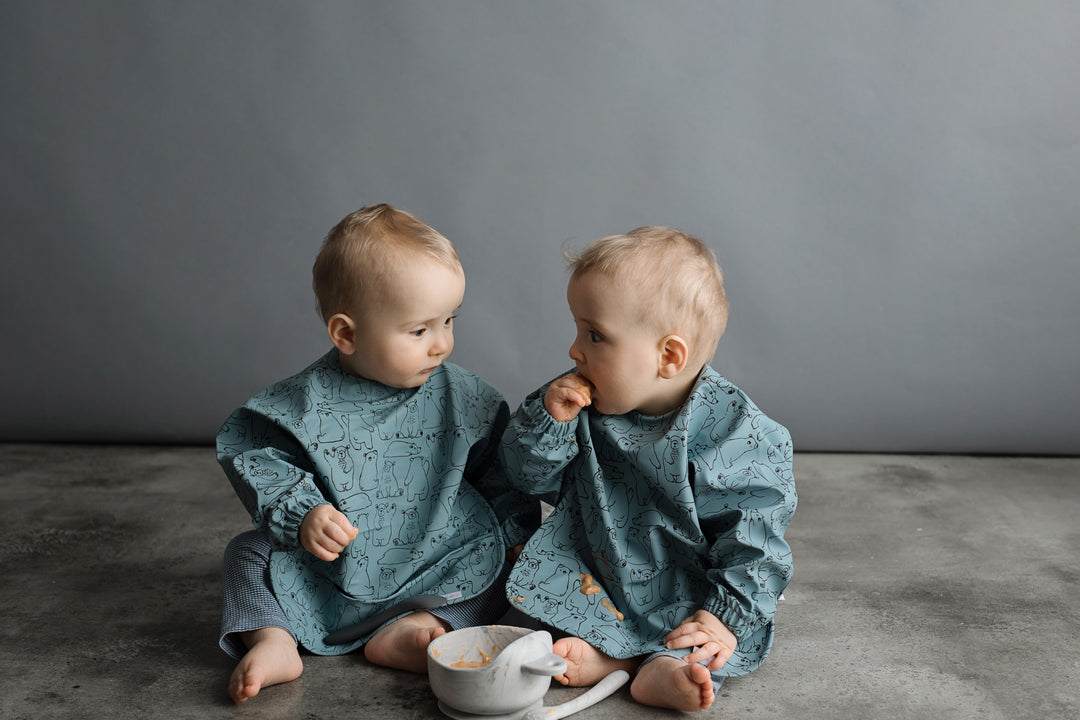
A waterproof top with elastic cuffs and a front pocket, closing at the back with snaps or Velcro. This is the workhorse style and what most families end up using daily.
Best for: everyday meals from about six months, daycare, anywhere you need a bib that goes on in five seconds.
What to look for: sleeves long enough to reach the wrist, a pocket that stays open on its own, a closure your baby can't undo with several snap positions at the neck, and waist ties to keep the bib sitting flat. The pocket position matters more than people expect. A high pocket sits at the chest, right at the height of the high chair tray, so it catches food the moment it drops from the mouth or hands. It's the better choice for the early months of BLW, when most of the food misses. A low pocket sits lower, near waist level, which gives the bib a sleeker, cleaner look. It comes into its own once your child is standing: at the water table, the easel or a sensory bin, drips run down the front and land in the pocket instead of on the floor. The pocket also makes a handy holder for a paintbrush, a sponge or a few crayons during creative play.

Whichever height you choose, check that the pocket is double-lined. A single layer of fabric lets food stain the inside of the pocket over time, and no amount of wiping brings it back. Every NEFERLAND pocket is double-lined so the inside stays clean after months of use.

Our version: the Classic High Pocket Long Sleeve Waterproof Bib, with a double-layered pocket placed higher on the torso. The pocket is convertible: flip it open at mealtime to catch everything that drops, then fold it flat and closed for painting, play or a trip out, when you'd rather it didn't collect crayons and sand. Available in two sizes from 6 months to 4 years. Month to month, it trades places with the NeferTie as our best seller.

2. Coverall bibs that attach to the tray
A long sleeve bib whose bottom edge fastens to the high chair tray, so the bib and tray form one continuous surface. Dropped food has nowhere to go. This is the one style that stays anchored no matter how much your baby pulls, and it's a different design from a smock bib: smocks sit on the body only, while a coverall bridges the gap between body and tray.

Best for: babies from six months up, especially the first few months of BLW when nearly everything gets dropped, and for babies who pull at their bib.
What to look for: a way to attach to the tray that works on your high chair. Most tray-attaching bibs use one method or the other. Suction cups grip smooth plastic trays but let go on wood or textured surfaces. An elastic strap goes around the tray edge and works on wooden or textured trays, but can slip on a wide or rounded tray. Having both means it works everywhere, including restaurant high chairs.

Our version: the NeferTie 2.0 Waterproof Coverall Bib is the only bib on the market with both suction cups and an elastic strap. No other bib does what it does: it has two methods of attachment, and the baby can't lift it off the tray. It's also the only NEFERLAND bib that attaches to the tray. It was the first product NEFERLAND made, after too many meals ended with a bib on the floor, and it's still the one we'd hand a new parent first. Adjustable neckline snaps let it grow with your baby.
3. Short sleeve smocks
Same idea as the long sleeve, with sleeves to the elbow. Cooler in summer, and a good match for babies who hate having their forearms covered. The front and lap stay protected while the arms stay free.
Best for: warm weather and summer meals, and as an activity smock for older children. For painting, play dough, baking and crafts with a three-, four- or five-year-old, a short sleeve smock is excellent: full coverage of the clothes, nothing in the way of the hands.
Our version: the Short Sleeve Waterproof Smock Bib, one size with waist ties, fits from about 1 year to around 6 years.
The fabric matters as much as the shape
A bib that's hard to clean doesn't get used. After the first week you'll want:
- Wipeable. Food should slide off with a damp cloth so you don't wash it after every meal. Look for a TPU or similar waterproof coating on the inside of the fabric rather than a plasticky outer layer. Tomato sauce is the real test; on a good coating it wipes off in one pass.
- Machine washable, cold. For the weekly deep clean: shake out the pocket, close the snaps, cold gentle cycle, then hang to dry. Skip the dryer, fabric softener and bleach, which all break down waterproof coatings over time. And don't leave a wet bib balled up in the diaper bag overnight, for the same reason you wouldn't leave a wet towel there.
- Stain resistant. Tomato sauce and turmeric are the real test. A fabric that holds a tomato stain after one wash isn't stain resistant whatever the label says.
- Safe to chew. Babies chew bibs, so the fabric matters as much as a teether would. Look for OEKO-TEX Standard 100 certification. It means every component of the fabric, including the coating, has been independently tested against a list of several hundred harmful substances and passed the strictest class, the one for baby articles. All NEFERLAND bibs carry it.
- Recycled where possible. Every NEFERLAND bib is made from 100% recycled polyester, about eight water bottles' worth per bib.
- Ethically made. A bib that's safe for your baby should also be made fairly by the people who sew it. NEFERLAND bibs are produced in facilities that follow safe and fair production practices, and we'd rather tell you that plainly than hide it in a footer.
Prints you won't find anywhere else
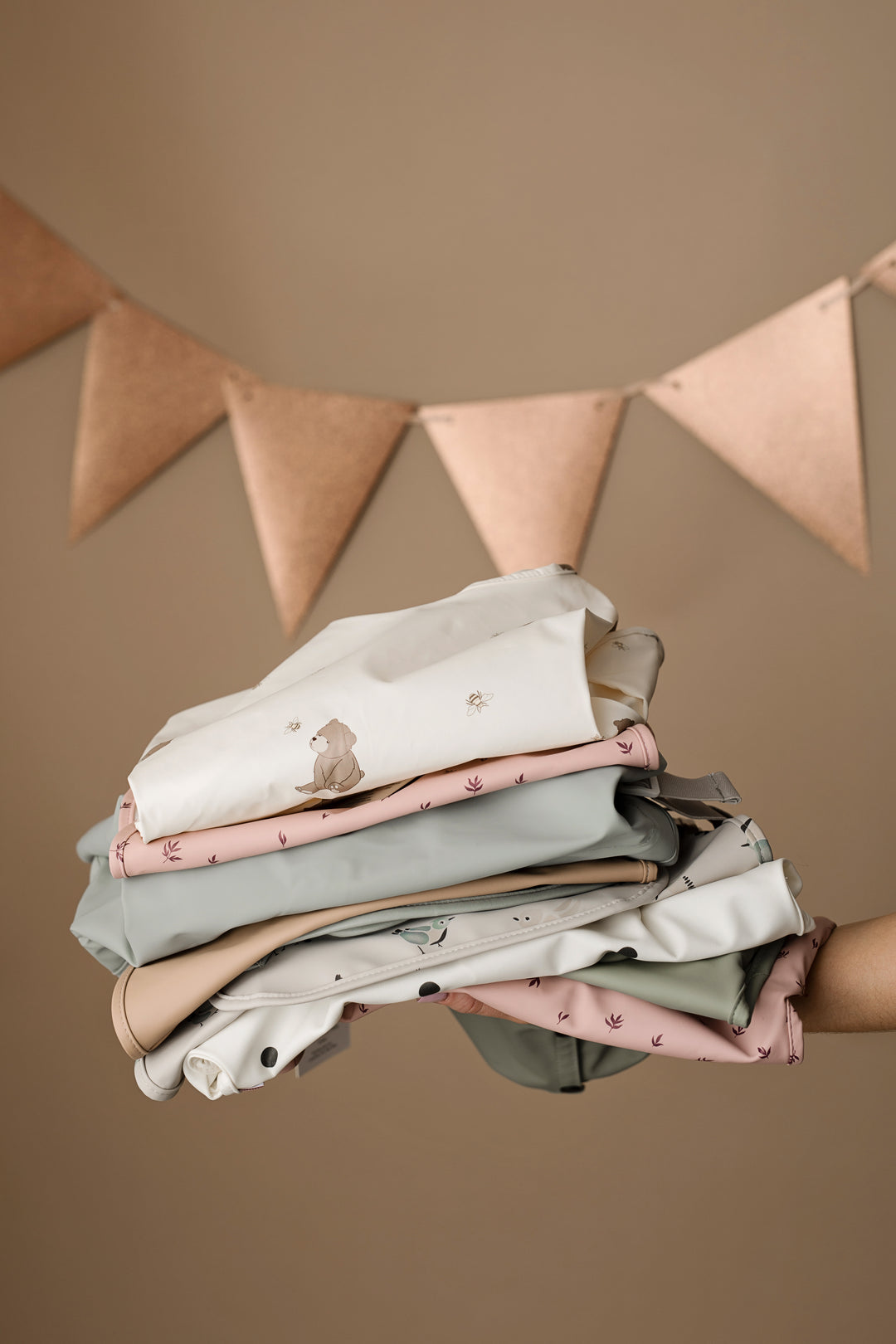
One more thing that's easy to overlook until you're looking at it three times a day: the print. Most bib patterns are stock designs licensed from a catalogue, which is why the same whale turns up on five different brands. Every NEFERLAND print is one of a kind. We commission artists to hand-paint each design in watercolour, the bears, the whales, the olive branches, and then transfer the original artwork to fabric. It's why the prints look soft and layered rather than flat, and why you won't see your baby's bib on anyone else's shelf. Pick the one you love; you'll be seeing a lot of it.


How many bibs do you actually need?
At least three. One on the baby, one drying, one clean in the drawer. Parents who buy one end up washing it nightly and then skipping it when it's still damp at breakfast. Parents who buy six find three of them never leave the drawer.
If your baby goes to daycare, add one to leave there. The same trick works at the grandparents' house: a bib that lives in their kitchen drawer is one less thing to remember to pack.
Bundles usually work out cheaper than buying two or three separately. Our starter bundles pair a coverall for the early months with long sleeve smocks for later, and the BLW bundles add a feeding course on top.
A fourth option for snacks and travel
Not every meal is a full BLW session. For quick snacks, lighter meals, the stroller or a restaurant where you don't want to wrestle sleeves on, a long sleeveless bib that covers the whole torso does the job. The Mega Classic Sleeveless is smaller than our smock styles but gives far more coverage than a traditional silicone bib, reaching down over the lap rather than stopping at the chest. One size fits from about 6 months to 6 years, so it's the bib that stays in rotation longest. It closes with Velcro at the side of the neck rather than the back, which avoids catching hair and makes it harder for a toddler to yank off. Keep one in the diaper bag; use the long sleeve or coverall at home.


What you can skip
- Silicone bibs for BLW. They cover a hand-sized patch of chest, leave the arms and lap bare, and most fasten with a loose loop a baby can yank off mid-meal. Fine for spoon-feeding later; wrong for the first year of self-feeding.
- "Bandana" or drool bibs for mealtime. They're for teething drool, not food.
- Non-waterproof, non-wipeable fabrics. Cotton and terry bibs soak food straight through to the clothes underneath, so you're back to changing outfits. And because they absorb rather than repel, every meal is a full wash rather than a wipe, which means more laundry, slower drying and a bib that's never clean when you need it.
- Anything hand-wash only. You won't.
- Single-lined pockets. One layer of fabric soaks up whatever lands in it. Within a few weeks the inside of the pocket yellows and stains, the smell lingers, and a bib that looked lovely in the box looks like something you'd rather not put on your baby. Look for a double-lined pocket; the difference shows after the first month.
Quick comparison
| Style | Arms covered | Catches drops | Attaches to tray | Best age |
|---|---|---|---|---|
| Silicone pocket bib | No | Some | No | 6 months+, spoon-feeding and neat eaters |
| Long sleeve smock, high pocket | Yes | Yes, at tray height | No | 6 months to 4 years |
| Long sleeve smock, low pocket | Yes | Yes, at waist | No | 6 months to 4 years |
| NeferTie coverall | Yes | Everything | Yes | 6 to 24 months |
| Short sleeve smock | Partly | Yes | No | 1 to 6 years, activities |
| Mega Classic sleeveless | No | Yes | No | 6 months to 6 years, snacks and lighter meals |
A note on gagging, mess and patience
Baby-led weaning is messy by design, and the mess is part of how babies learn about texture and feeding themselves. The right bib doesn't make meals clean. It makes the clean-up a thirty-second wipe instead of a bath and a load of laundry, which is what keeps you saying yes to the next messy meal. If you have questions about readiness or safety, your pediatrician or a registered dietitian is the right person to ask; this guide is about the gear, not the nutrition.
If you'd like that guidance alongside the gear, our BLW bundles pair NEFERLAND bibs with a baby-led feeding course and meal plan from the pediatric dietitians at My Little Eater. Choose The Path Finder for one bib and the course, The Voyager for two bibs, or The Master Explorer for three, so you start solids with the bibs and the know-how in one box.
Ready to start? See the full range of waterproof bibs or pick a bundle for the first six months. And if you're wondering about the name: "nefer" is the ancient Egyptian word for beautiful and complete, and Neverland is where children never grow up. Timeless designs you can hand down to the next baby were the idea from the start.